← nickconenna.com The books Read the opening The units Notes Reader list

A novel series in four volumes

The Cubitand theQuark

0 Mille passus — a thousand paces to the Roman mile 68 ◂ he stopped here

A man is shot at four in the morning at the foot of Tesla's tower. He has eleven minutes left, and he spends them walking in a straight line, counting.

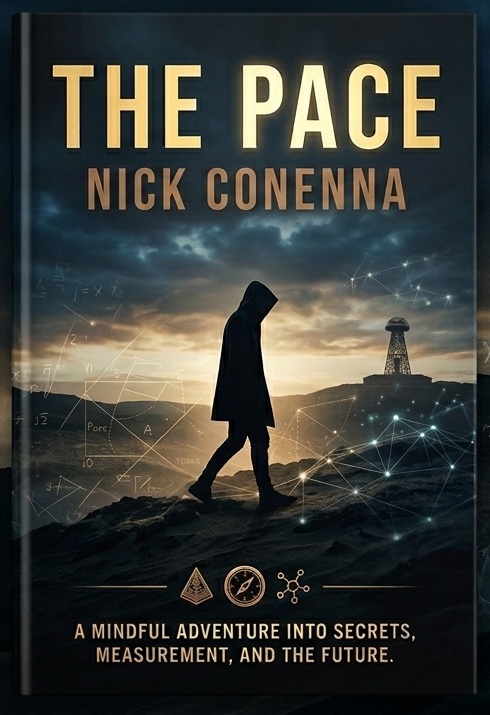
THE PACE, by Nick Conenna — a hooded figure walks toward the Wardenclyffe tower under a clouded sky, ringed by faint geometric equations and a constellation of measurement points.

Book I · The Pace

The premise

He can measure anything except people

A metrologist tells the time without a clock and the distance without a tape. He knows the circumference of the earth in breaths, dates a building by the unit it was built to, and can say how long he has been unconscious to the minute. He has never once been able to read a man across a table.

His stepfather has just been murdered at Wardenclyffe — and spent the last eleven minutes of his life pacing a deliberate line across a field, because there is exactly one person alive who would look at a body in the weeds and ask the correct question.

Not what killed him. How far did he walk.

Before you begin

Fact

  • For 130 years the kilogram was a cylinder of platinum-iridium in a vault at Sèvres, behind three keys held by three separate parties. It drifted. In 2019 it was retired and redefined against the Planck constant.
  • In 1834 the Palace of Westminster burned, destroying the imperial standards of the yard and the pound. Replacements took more than a decade. For those years the yard did not exist — and almost nobody noticed.
  • In 1901 J.P. Morgan financed the tower at Wardenclyffe believing he was buying wireless telegraphy. When he understood Tesla intended to transmit power instead, he withdrew and never wrote another cheque.
  • A circle holds 21,600 arcminutes. A nautical mile is one arcminute of latitude. The earth is 21,600 nautical miles around. A human day, in the yogic count, is 21,600 breaths.
  • In November 1910, six men travelled to Jekyll Island using only their first names, behind a duck-hunting cover story, to draft what became the Federal Reserve.

All of the above is true

The series

Each volume is named for a unit of measure

The books move outward from the body to the institution. Every unit in them is real, inherited, and chosen by someone none of us ever met.

I
The Pace Published

mille passus — a thousand double steps of a marching soldier

Which is why every highway sign in America still counts a Roman's legs. A murder at Wardenclyffe, a private key hidden as a physical length, and a standards vote that will decide what the world's cryptography looks like for the next hundred years.

Ebook & paperback live on Amazon · audiobook in production

Read Book I →
II
The Fathom Outlined

fæthm — Old English for embrace

The span of a man's outstretched arms. Sailors measured the depth of the sea in hugs. Almost all of the world's data crosses the ocean floor on cables owned by a handful of companies — and one seabed survey appears on no chart.

III
The Breath Outlined

21,600 a day — one per nautical mile

A day around the body is a day around the planet. Orbit, where the clock on the bench and the clock in the sky disagree by an amount that is small, measurable, and worth more than most countries.

IV
The Standard Outlined

the object a unit is defined against

Also the thing that backs a currency, and the banner you carry into a fight. Sèvres, the vault with three keys, and the question the series has been asking since a dying man walked sixty-eight paces across a field: who holds it.

The opening

The Pace — Prologue

Wardenclyffe · Shoreham, New York · 4:11 a.m.

Dr. Ambrose Teague had eleven minutes left and he intended to spend them walking.

The brick laboratory behind him was the last building Stanford White designed before a jealous husband shot him in the face at Madison Square Garden. Teague had always thought that was the honest epigraph for this place. Everything here had ended badly and none of it had been wrong.

The tower was gone — sold for scrap in 1917 against a hotel bill. But the foundation remained under the weeds. An octagon of concrete, and beneath it the shaft, sunk a hundred and twenty feet into Long Island sand, because Tesla had insisted that to grip the earth you must first get your hand around it.

Behind him, the woman was still coming. She had not hurried once.

That was the detail he could not stop noticing, even with his shirt going warm and heavy against his ribs. She walked at a fixed rate. She had walked at that rate through the parking lot, through the treeline, through the twenty minutes it took her to find him, and she was walking at it still. A metronome inside a person. Teague had spent forty-one years measuring things and he knew a calibrated instrument when he saw one.

"Doctor." Her voice was pleasant. "You've made your point. Where is it?"

He did not answer. He put his left foot down, then his right, and he counted.

Keep reading →
What it's about

The argument

A measure taken from the body, against a measure imposed on it

The cubit is the largest human-scaled unit. The quark is the floor of matter. Everything between them is contested territory.

Most arguments that look like they are about money are actually about measurement. Whoever defines the unit is usually not in the room, and has usually already won.

The antagonist

He is right about something, and that is the problem

He watched his grandmother paper a kitchen wall with banknotes in 1923. He concluded, before he was nine, that somebody must be responsible for the ruler.

A measure without a keeper is not free. It is unguarded. He is never refuted in these books. He is only outvoted.

The wound

A man who is never late, and thirty years too late

Greek carried two words for time. Chronos is countable and sequential — his entire life. Kairos is the appointed moment, which arrives on no schedule and cannot be produced by counting.

He has mastered one and has never once been on time for the other.

The instruments

Every unit here came off a human body

The reader is not required to remember any of this. The protagonist cannot forget it.

Digit
A finger's width. The smallest unit anyone ever needed, and the one you always have with you.
Palm
Four digits. Horses are still measured in hands, which is the same idea wearing a different hat.
Span
Thumb-tip to little-finger-tip on a spread hand. Half a cubit, near enough, on most men.
Cubit
Elbow to fingertip. The largest unit that is still a person. The Great Pyramid is built in these.
Foot
A foot. Twelve inches because twelve divides cleanly by two, three, four and six, and ten does not.
Pace
A double step. Mille passus — a thousand of them — is the Roman mile, and therefore the American one.
Fathom
Both arms outstretched. From fæthm, an embrace. The sea was measured in hugs.
Canna
The canna napoletana — eight palms, the working measure of the Kingdom of Naples, and so of Bari. It is also the protagonist's surname.

The research notebook

Essays from underneath the books

The research came first and would not stay in a notebook. Each of these stands on its own, and each one is load-bearing somewhere in the series.

01

The Meter Problem

Why J.P. Morgan killed Tesla's tower, and what it tells you about every fight coming in the next ten years. You cannot sell what you cannot meter.

Read →
02

21,600

A human day is 21,600 breaths. The earth is 21,600 nautical miles around. Same number, same inherited base — and nobody alive chose it.

Forthcoming
03

The Kilogram Died in 2019

For 130 years every kilogram on earth was a copy of one cylinder outside Paris. Then it drifted, and we retired it, and started measuring against a constant instead.

Forthcoming
04

Six Men Went to Jekyll Island

In 1910 they travelled under first names only, behind a duck-hunting cover story, to draft what became the Federal Reserve. The documented version needs no conspiracy, which makes it worse.

Forthcoming
05

The Prayer Says Debts

English liturgy says trespasses. The Aramaic word is ḥawbā, and it carries debt and sin in one piece with no seam between them.

Forthcoming
06

The Yard Did Not Exist

Westminster burned in 1834 and took the standards with it. For over a decade there was no yard to point at, and commerce carried on regardless. A standard was never an object. It was an agreement.

Forthcoming

How these are made

I write with AI. Not have an AI write it — the distinction matters and I draw it precisely in the author's note. I bring the obsessions, the family material, the thematic commitments, and the veto. The collaboration brings research, structure, drafting at volume, and persistent argument.

Every historical claim in these books is checkable, and a historical note in each volume separates what is real from what is invented. Under current U.S. Copyright Office guidance, AI-generated material is not itself copyrightable and registration requires disclosure. That disclosure is made.

I would rather say so on page one than be asked about it later.

Reader list

The Cubit and the Quark · a novel series by Nick Conenna
Book I: The Pace · Research notes · Applied AI work →